

Table of Contents
Introduction
Trading is often marketed as a technical challenge, where mastering indicators, chart patterns, and strategies supposedly leads to consistent profits. In reality, this belief is one of the main reasons most traders fail. The true battlefield is not the chart; it is the trader’s mind. Psychology, not strategy, is the silent force behind the majority of blown accounts, emotional decisions, and repeated cycles of loss.
Every year, thousands of new traders enter the markets with motivation, optimism, and confidence. Many of them learn strategies that genuinely work under controlled conditions, yet they still fail to apply those strategies consistently. The reason is simple but uncomfortable: trading exposes emotional weaknesses faster than almost any other profession. Fear, greed, impatience, and ego surface under pressure, often overriding logic and discipline.
This article explores why most traders fail, not from a technical perspective, but from a trading psychology standpoint. You will learn the most common psychological mistakes traders make, how those mistakes manifest in real trading behavior, and how professional traders train themselves to think differently. By the end, you will understand why psychology is the foundation of trading success and how to begin correcting the mental habits that quietly sabotage performance.
The Real Statistics Behind Trading Failure
Before diving into psychology, it is important to confront the reality of trading outcomes. Various studies and broker disclosures consistently show that 70% to 90% of retail traders lose money over time. This failure rate remains remarkably stable across markets, including stocks, forex, futures, and cryptocurrencies.
This consistency reveals an important truth:
If most traders fail in every market, under every condition, and with every strategy, then the problem cannot be the market itself. The problem lies in human behavior.
Markets are neutral systems driven by supply and demand. They do not punish traders personally, yet traders often experience losses as emotional events. This emotional interpretation leads to poor decisions, overtrading, revenge trading, and abandonment of proven plans.
Why Trading Psychology Matters More Than Strategy
Many beginners believe that once they find the “right strategy,” success will follow automatically. This belief is comforting, but it is false. A strategy is only a set of rules. Psychology determines whether those rules are followed.
A trader with average technical knowledge and excellent discipline will outperform a trader with advanced technical knowledge and poor emotional control. This is why professional traders focus far more on process and execution than on constantly searching for new setups.
Psychology affects trading in several critical ways:
- It determines whether you follow your trading plan under pressure
- It controls how you respond to losses and drawdowns
- It influences position sizing and risk behavior
- It shapes patience, consistency, and confidence
Without psychological stability, even a profitable strategy becomes untradable in real conditions.

The Core Psychological Mistakes That Cause Traders to Fail
1. Fear of Losing Money
Fear is the most dominant emotion in trading, especially for beginners. It often appears as hesitation, early exits, or avoidance of valid setups. Traders fear being wrong more than they value following their plan, which leads to inconsistent execution.
Fear-driven behavior includes:
- Closing winning trades too early
- Moving stop losses away to avoid being stopped out
- Skipping high-quality setups after recent losses
Ironically, fear often increases losses instead of preventing them.
2. Greed and Overconfidence
Greed is the emotional opposite of fear, yet it is equally destructive. After a series of wins, traders often feel invincible. This emotional high leads to oversized positions, ignoring risk rules, and chasing trades far from logical entries.
Common signs of greed include:
- Increasing position size without statistical justification
- Refusing to take profits because “price might go further”
- Overtrading after winning streaks
Greed turns profitable periods into eventual account drawdowns.
3. Revenge Trading After Losses
One of the fastest ways traders fail is through revenge trading. After a loss, especially an emotionally painful one, traders feel an urge to “get the money back.” This mindset transforms trading from a decision-making process into an emotional reaction.
Revenge trading usually results in:
- Entering low-quality setups
- Ignoring market structure or context
- Breaking daily loss limits
- Escalating losses rapidly
Professional traders understand that losses are part of the business, not personal attacks.
4. Lack of Patience and Overtrading
Modern markets reward patience, yet many traders feel the need to always be in a trade. This impatience is often driven by boredom, FOMO, or unrealistic expectations of constant action.
Overtrading leads to:
- Reduced trade quality
- Increased transaction costs
- Emotional exhaustion
- Lower overall expectancy
Waiting is a trading skill, not wasted time.
5. Emotional Attachment to Trades
Many traders subconsciously tie their self-worth to individual trades. When a trade goes against them, they feel personally attacked. When it goes in their favor, they feel validated.
This emotional attachment causes traders to:
- Defend losing trades instead of managing them
- Ignore invalidation signals
- Break risk rules to “prove they are right”
Professional traders remain emotionally neutral toward outcomes.
Psychological Traps That Repeat Failure Cycles
The most dangerous aspect of trading psychology is not individual mistakes, but repeating patterns. Traders often cycle through hope, excitement, fear, frustration, and despair without understanding why results never stabilize.

This visual helps readers understand how emotions, not strategy, drive repeated failure.
How Professional Traders Think Differently
Professional traders are not emotionless. They simply structure their trading in a way that minimizes emotional interference. Their psychology is shaped by systems, rules, and expectations grounded in probability.
Key mindset differences include:
| Retail Trader Mindset | Professional Trader Mindset |
|---|---|
| Focused on winning trades | Focused on executing rules |
| Emotional attachment to outcomes | Emotional neutrality |
| Seeks certainty | Accepts uncertainty |
| Trades to feel something | Trades as a process |
| Measures success daily | Measures success over samples |
Professionals think in series of trades, not individual outcomes.
The Role of Market Structure in Psychological Stability
One of the most effective ways to reduce emotional trading is by anchoring decisions to market structure. Structure provides context, logic, and boundaries that protect traders from impulsive behavior.
By understanding trends, swing points, and transitions such as BOS and CHOCH, traders stop reacting emotionally and start responding objectively.
To build a strong foundation in this area, we strongly recommend reading our in-depth internal guide on market structure:
👉 Market Structure Guide: BOS & CHOCH (2026)
This guide explains how structure creates clarity and reduces emotional decision-making.
Risk Management as a Psychological Safety Net
Risk management is not just a financial tool; it is a psychological stabilizer. Traders who define risk clearly before entering a trade dramatically reduce emotional stress during execution.
| Risk Rule | Psychological Benefit |
|---|---|
| Fixed risk per trade | Reduces fear |
| Daily loss limit | Prevents revenge trading |
| Position sizing formula | Removes guesswork |
| Predefined stop-loss | Creates emotional boundaries |
When risk is controlled, emotions lose their power.
Why Consistency Beats Talent in Trading
Many talented traders fail because talent without discipline leads to inconsistency. Consistency, not brilliance, creates long-term profitability.
Consistency comes from:
- Repeating the same execution process
- Accepting losses calmly
- Avoiding emotional deviations
- Trusting probabilities over feelings
Professional traders do not aim to be right. They aim to be consistent.
Common Psychological Lies Traders Tell Themselves
Traders often sabotage themselves with internal narratives that sound logical but are emotionally driven.
Examples include:
- “This one looks different, I’ll risk more”
- “I’ll just take one more trade today”
- “The market owes me after those losses”
- “I can’t miss this move”
Recognizing these thoughts is the first step toward controlling them.
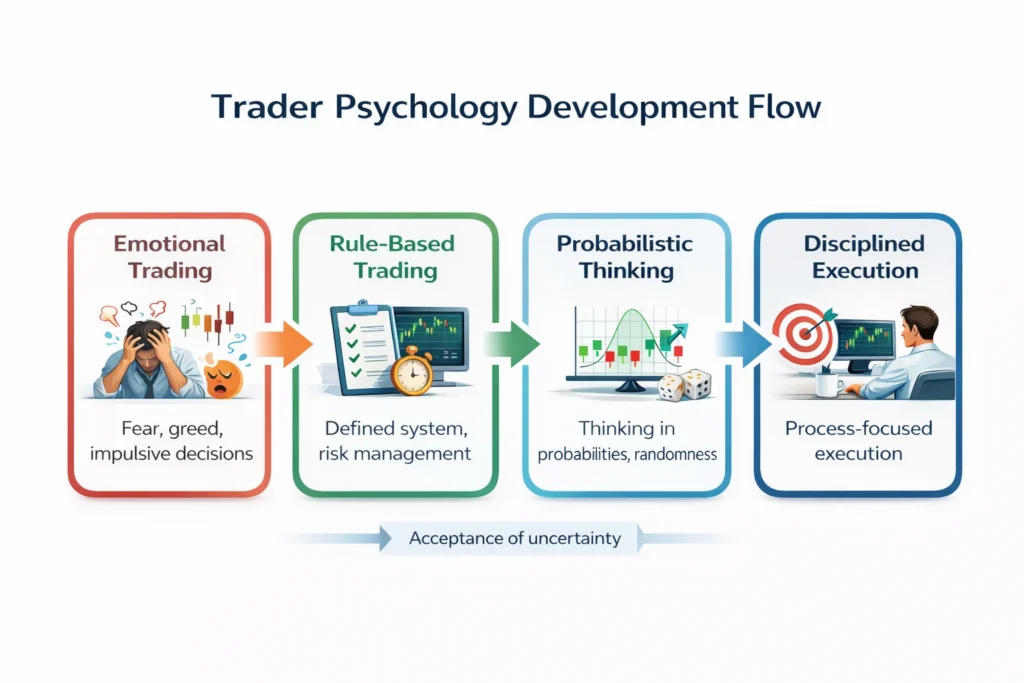
Building a Strong Trading Psychology Step by Step
Developing psychological strength is not about eliminating emotions; it is about structuring behavior.
🔹 Where to place Diagram 2
To deepen your understanding of trading psychology and behavioral finance from trusted educational sources, we recommend exploring the following external resources:
Behavioral finance research from Wikipedia provides a solid academic foundation for understanding why humans make irrational decisions in financial markets and how cognitive biases affect traders
Additionally, the psychology of risk and decision-making is well explained in Prospect Theory, which describes how people perceive gains and losses asymmetrically
These resources complement the concepts discussed in this article and reinforce the psychological principles behind trading behavior.
Frequently Asked Questions (FAQ)
Why do most traders fail even with good strategies?
Because strategies require consistent execution, and emotional reactions often override rules during live trading conditions.
Can trading psychology really be trained?
Yes, through structured risk management, journaling, repetition, and probabilistic thinking.
How long does it take to improve trading psychology?
Most traders see improvement within months when they focus on process instead of profits.
Is psychology more important than technical analysis?
Psychology determines whether technical analysis is applied correctly, making it more important in practice.
Can market structure help with emotions?
Yes, structure provides objective context, which reduces impulsive and emotional decisions.
Conclusion: Fix the Mind, Fix the Results
Most traders fail not because the market is unfair, but because they underestimate the psychological demands of trading. Fear, greed, impatience, and ego quietly sabotage execution, even when the strategy itself is sound.
Trading success begins when traders stop fighting emotions and start designing systems that limit emotional influence. By understanding trading psychology, applying strict risk management, anchoring decisions to market structure, and measuring success over large samples, traders give themselves a real chance to succeed.
If you want to improve your results, do not search for another strategy. Instead, rebuild how you think, how you react, and how you execute. When the mind becomes disciplined, the results follow naturally.