

Table of Contents
Introduction: Why Unrealized Profits Don’t Feel Like Success
Most traders assume the hardest part of trading is taking losses. In reality, many discover something far more confusing once they start improving: unrealized profits feel deeply uncomfortable. Instead of relief or confidence, winning trades often create tension, restlessness, and a constant urge to interfere. The larger the unrealized profit grows, the more unstable it feels. Traders begin watching every tick, questioning every pause, and mentally negotiating exits long before structure actually changes.
This reaction feels irrational, especially to traders who have worked hard to become profitable. After all, unrealized profits represent progress. Yet for many, being “up” feels more stressful than being wrong. This article explains why unrealized profits trigger discomfort, how they distort decision-making, and how professional traders learn to remain neutral while in profit—without forcing exits or sabotaging expectancy.
Why Unrealized Profits Trigger Psychological Threat
Unrealized profits activate a different psychological response than losses. While losses create immediate pain and finality, unrealized profits create exposure. From the brain’s perspective, unrealized profits are not owned—they are at risk. The moment a trade moves into profit, the nervous system shifts from analysis to protection. Instead of evaluating probability, the mind begins scanning for danger.
This shift happens quietly. The trader still believes they are being rational, careful, and disciplined. In reality, the brain has entered loss-avoidance mode. Every fluctuation now carries emotional weight because there is something visible to lose. Unrealized profits place the trader in a state of ownership without security, which is one of the most uncomfortable psychological positions the mind can occupy.
Why Being in Profit Feels Unsafe
Unrealized profits remove neutrality. Before entry, the trader observes price movement as information. Once in profit, price movement becomes evaluative. Each pullback is subconsciously processed as a potential loss, even though no loss has occurred yet. This is why traders often feel hyper-aware while winning. They watch screens more closely, feel uneasy stepping away, and react faster to normal retracements.
This discomfort is not greed. It is nervous system activation. The brain treats unrealized profits as something fragile that must be defended. As a result, many traders begin managing feelings rather than managing trades. Stops are adjusted emotionally, exits are rushed, and original trade logic quietly dissolves under the pressure to “not give it back.”
The Conflict Between Patience and Fear in Unrealized Profits
Holding unrealized profits creates an internal conflict that drains mental energy. One part of the trader understands that the setup remains valid and that expectancy depends on allowing trades to develop fully. Another part is consumed by fear of reversal, regret, and self-blame. This tug-of-war intensifies the longer the trade stays open in profit.
The danger is not the feeling itself, but how convincing it becomes. Traders interpret discomfort as a warning, rather than recognizing it as a biological response to uncertainty. Over time, this leads to premature exits that feel justified in the moment but erode performance over dozens of trades.
Why Unrealized Profits Are More Dangerous Than Losses
Losses hurt once. Unrealized profits distort behavior continuously. While a realized loss ends uncertainty, unrealized profits extend it indefinitely. The trader remains suspended between hope and fear, constantly evaluating whether to act. This prolonged ambiguity exhausts cognitive resources and increases the likelihood of emotional decisions disguised as prudence.
This is why many technically sound strategies fail in execution. The strategy itself may be profitable, but the trader cannot tolerate the psychological cost of holding unrealized profits. Without understanding this dynamic, traders often blame exits, timing, or discipline—when the real issue is emotional ownership forming too early.
The Brain Doesn’t Treat Unrealized Profits as Real Money
From a psychological standpoint, unrealized profits are not experienced as money. They are experienced as potential loss. Until profit is realized, the brain treats it as something that can still be taken away. This is why the reward system does not activate in the way traders expect. Instead of dopamine, the nervous system produces vigilance.
As soon as a trade moves into profit, psychological ownership forms. The trader feels responsible for protecting the gain even though it has not been secured. This mismatch—ownership without finality—is the root of discomfort. The trader feels accountable for an outcome they do not control.
Why Traders Rush Profits but Tolerate Losses
One of the most common behaviors in trading is rushing winners while sitting with losers. Psychologically, this makes perfect sense. Losses offer closure. They end uncertainty. Unrealized profits do the opposite. They prolong responsibility. Closing a winning trade early provides emotional relief, certainty, and safety—even if it damages long-term expectancy.
The brain prefers small, guaranteed wins over open-ended upside. This preference is rooted in survival, not optimization. Unrealized profits force the trader to tolerate ambiguity, which the mind strongly resists. As a result, traders often exit winners early not because they lack patience, but because they seek relief from psychological tension.
How Unrealized P&L Distorts Decision-Making
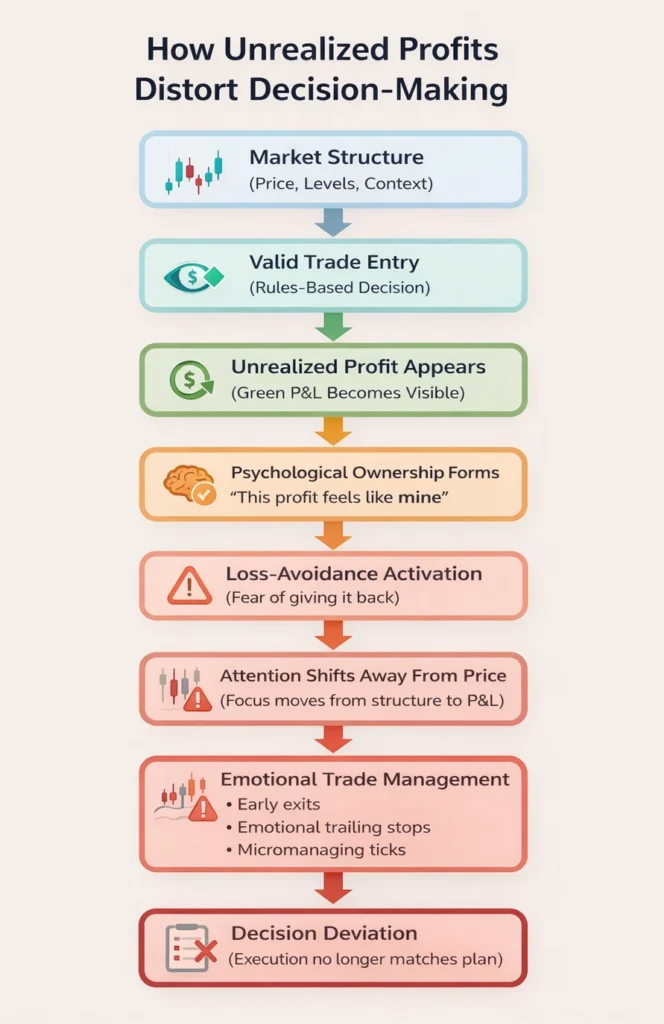
Once unrealized profits become visible, they often become the trader’s reference point. Pullbacks feel like losses. Normal retracements feel threatening. Structure is interpreted emotionally rather than objectively. Decision-making shifts from probability-based to defense-based.
Instead of managing the trade, the trader begins managing their emotional relationship with money. Stops are tightened emotionally. Targets are adjusted impulsively. The illusion of control increases, while actual execution quality declines. This is why many traders feel relief—not confidence—after closing winning trades.
The Difference Between Earned and Unearned Money
Unrealized profits feel uncomfortable because they are not psychologically earned yet. Realized profits bring closure. Unrealized profits bring responsibility. The mind treats provisional rewards as burdens rather than benefits. Traders feel pressure to protect gains they do not yet own, which creates anxiety and self-judgment.
Once profit becomes visible, imagined futures attach to it. Traders project what the profit represents, what it could fix, and what it says about them. This symbolic value increases emotional attachment and makes normal fluctuations harder to tolerate.
How Unrealized Profits Distort Decision-Making
How Professional Traders Stay Neutral While in Profit
Professional traders do not eliminate the discomfort of unrealized profits. They remove its authority. They refuse to mentally spend unrealized money or treat it as earned. As long as a trade is open, profit is treated as market information—not personal gain.
Decisions remain anchored to structure, thesis, and predefined exits. Professionals expect discomfort and do not interpret it as a signal. Because they do not emotionally negotiate with unrealized profits, execution remains stable even when tension exists.
Letting winners run is psychologically expensive. Professionals accept that cost as part of expectancy. They understand that some profits will retrace or disappear entirely. This is not failure—it is variance.
A Note on Risk, Psychology, and Capital Protection
Understanding how unrealized profits affect behavior is a cornerstone of professional trading psychology. Research in behavioral finance consistently shows that loss aversion and emotional ownership distort financial decisions under uncertainty. A neutral explanation of how these mechanisms operate can be found in Investopedia’s behavioral finance resources, which provide a solid external reference for this topic. Internally, this concept connects directly with execution discipline and capital protection frameworks discussed in Profit Protection and Trading Psychology and in Surviving Brutal Losing Streaks in Trading, where emotional neutrality is treated as a risk management skill rather than a personality trait.
Frequently Asked Questions
Why do unrealized profits feel more stressful than losses?
Because unrealized profits activate loss-avoidance systems. The brain treats visible gains as something that can still be taken away.
Is it normal to feel anxious while in profit?
Yes. This reaction is biological and predictable, especially as unrealized profits grow.
Why do I exit winning trades too early?
Early exits often provide emotional relief by ending uncertainty, even when they hurt expectancy.
Why do I feel calmer in losing trades?
Losses offer certainty and familiarity, while unrealized profits extend responsibility and ambiguity.
Can unrealized profit discomfort be eliminated?
No—but it can be understood and neutralized so it no longer drives decisions.
How Unrealized Profits Shape Behavior Over Time
One of the least discussed dynamics in active markets is how repeated exposure to open gains gradually conditions behavior. Early on, the discomfort of holding a profitable position is loud and unmistakable, but with experience it often becomes quieter rather than disappearing. The nervous system learns to anticipate the tension associated with gains that are not yet secured, and this anticipation alone begins to influence decisions before a trade even fully develops. Over time, this learned response can shape how traders enter positions, manage risk, and exit trades — not in pursuit of better outcomes, but in an effort to reduce internal discomfort while still believing they are acting logically.
This conditioning process explains why many traders show inconsistency around winning trades despite having sound technical rules. With repetition, open gains become associated with pressure, responsibility, and vulnerability rather than opportunity. The mind starts linking success with emotional strain. As a result, subtle avoidance patterns emerge. Traders may exit earlier than planned, reduce position size prematurely, or monitor price excessively, not because market structure demands it, but because unresolved gains have become mentally taxing. At that point, decisions are no longer driven by price behavior alone, but by an expectation of internal stress.
Another important consequence of this pattern is its indirect impact on confidence. Secured profits tend to reinforce self-trust because they bring closure. Open gains do the opposite. Because they remain reversible, they keep the trader in a constant state of evaluation. Every pullback feels meaningful. Every pause invites doubt. What should be seen as normal price behavior can begin to feel like personal failure. Over time, this makes confidence paradoxically weaker during periods of success than during periods of struggle — one of the most counterintuitive traps market participants face.
The long-term result is a skewed performance profile. Many traders unknowingly become more composed under pressure and more reactive during favorable conditions. Execution quality improves when defending against loss but deteriorates when opportunity expands. This imbalance never appears in backtests or written plans, yet it steadily erodes real-world results. When left unexamined, traders often blame their methods, assuming something is technically wrong, when the real issue lies in how open gains are mentally experienced and managed.
Recognizing this pattern is essential for building durability. Open profits are not a temporary emotional hurdle; they are a recurring psychological event that shapes habits, expectations, and decision-making frameworks over time. Those who learn to normalize the tension stop treating it as a signal that requires action. Instead, it becomes background noise — expected, predictable, and irrelevant to execution quality. That shift alone creates a meaningful edge, not by changing strategy, but by restoring neutrality where it matters most.

Conclusion: Unrealized Profits Are a Psychological Test
Unrealized profits feel uncomfortable because they place the mind in a state it resists: ownership without certainty and responsibility without control. This discomfort is not a flaw. It is a biological response. The problem arises when traders mistake the feeling for instruction.
The traders who last are not those who feel comfortable while winning. They are those who can hold unrealized profits without attachment, allow structure to play out, and remain neutral while outcomes resolve. Mastery is not eliminating discomfort—it is trading without responding to it.