

Table of Contents
Introduction
Most traders don’t fail because they lack motivation. They fail because they are surrounded by the wrong information.
Open YouTube, Twitter, Discord, or Reddit and you’ll immediately see the problem. Thousands of traders sharing strategies, indicators, screenshots, and bold claims about profits. New tools appear every week. New systems promise faster results. New “gurus” claim to have discovered the secret to beating the market.
But after months — sometimes years — most traders are still stuck in the same place.
The issue is rarely intelligence or effort. It is resource chaos.
Traders consume dozens of disconnected sources: random YouTube videos, untested indicators, social media opinions, and trading groups full of emotional commentary. Instead of building structured knowledge, they accumulate fragments of information that never form a real edge.
Professional traders approach resources differently.
They treat their environment as part of their strategy.
The books they read shape how they think about risk.
The platforms they use shape how they execute trades.
The tools they use shape how they analyze performance.
And over time, those choices determine whether a trader slowly develops skill — or stays trapped in a cycle of confusion.
This guide is not another list of trendy tools. It is a structured blueprint of the trading resources serious traders actually rely on in 2026, including:
- Foundational books that shape professional thinking
- Platforms used for charting and execution
- Journaling systems that reveal real performance data
- Risk management tools that protect capital
- Communities that support growth instead of hype
- And a framework for building your own resource stack
If you want to treat trading like a profession instead of a hobby, the resources you choose will matter far more than the next indicator you download.
Let’s begin with the most overlooked foundation of trading skill.
Why Most Traders Use the Wrong Resources
Before discussing tools or books, it is important to understand why traders struggle with learning in the first place.
The modern trading environment rewards speed and excitement rather than depth.
Short videos promise quick strategies. Social media posts showcase massive profits without showing risk. Trading groups focus on signals instead of understanding. All of this creates the illusion that success comes from discovering the right entry technique.
In reality, the opposite is true.
Professional traders focus first on process, not signals. They build frameworks for risk management, decision-making, and self-analysis before worrying about trade entries.
When traders skip this foundation, they become dependent on external information instead of developing internal structure. That dependency leads to constant strategy switching, emotional trading, and inconsistent results.
Understanding this dynamic is critical because it explains why the right resources accelerate growth while the wrong ones create years of stagnation.
Foundational Trading Books That Shape Professional Thinking
Before subscribing to expensive tools or joining trading communities, serious traders build their thinking through structured reading.
Books remain one of the few formats that force deeper understanding. Unlike social media content, they present complete frameworks instead of fragmented ideas.
Several trading books have maintained relevance for decades because they address human behavior in markets, which rarely changes.
Some of the most respected titles among professional traders include works that focus on psychology, probabilistic thinking, and risk management. Books such as Trading in the Zone by Mark Douglas and Market Wizards by Jack Schwager continue to shape how traders understand discipline and performance. Historical perspectives from works like Reminiscences of a Stock Operator remain valuable because they illustrate how crowd psychology drives market cycles.
These books matter because they train traders to think differently about uncertainty, losses, and decision-making. Instead of searching for certainty, experienced traders learn to operate within probabilities.
That shift in perspective often marks the difference between a trader who constantly chases strategies and one who builds a consistent process.
Charting and Execution Platforms Traders Actually Use
Even the best strategy cannot overcome a poor execution environment.
Platforms influence everything from chart analysis to order execution speed. In 2026, several platforms dominate different segments of the trading industry.
TradingView has become the standard for chart analysis due to its intuitive interface, multi-timeframe tools, and cloud accessibility. It allows traders to monitor multiple markets while keeping their analysis organized.
For futures traders, platforms such as NinjaTrader and Sierra Chart remain popular because they offer advanced order-flow tools and professional execution features. These platforms allow traders to analyze depth-of-market data, volume profiles, and footprint charts — tools often used by institutional traders.
Forex traders still rely heavily on MetaTrader 5 due to its global broker compatibility and support for automated trading systems.
While each platform has strengths and weaknesses, the most important factor is consistency. Traders who constantly switch platforms often struggle to build execution discipline. Mastery of a single trading environment usually produces far better results.
Trade Journaling: Where Real Trading Improvement Happens
One of the biggest differences between casual traders and professionals is how they review their performance.
Most traders analyze charts.
Very few analyze their own behavior.
Journaling transforms trading from guesswork into measurable improvement. By tracking entries, exits, risk levels, emotional states, and rule adherence, traders begin to identify patterns in their decision-making.
Modern journaling platforms such as TradeZella and Edgewonk provide advanced analytics that reveal statistical insights about performance. These tools allow traders to analyze win rates, risk-to-reward ratios, time-of-day performance, and expectancy.
Even simple spreadsheet journals can be extremely effective when used consistently. The goal is not just to record trades but to identify recurring behaviors — such as overtrading, poor risk control, or emotional decision-making.
Over time, this data becomes one of the most valuable resources a trader possesses because it reveals exactly where improvement is needed.
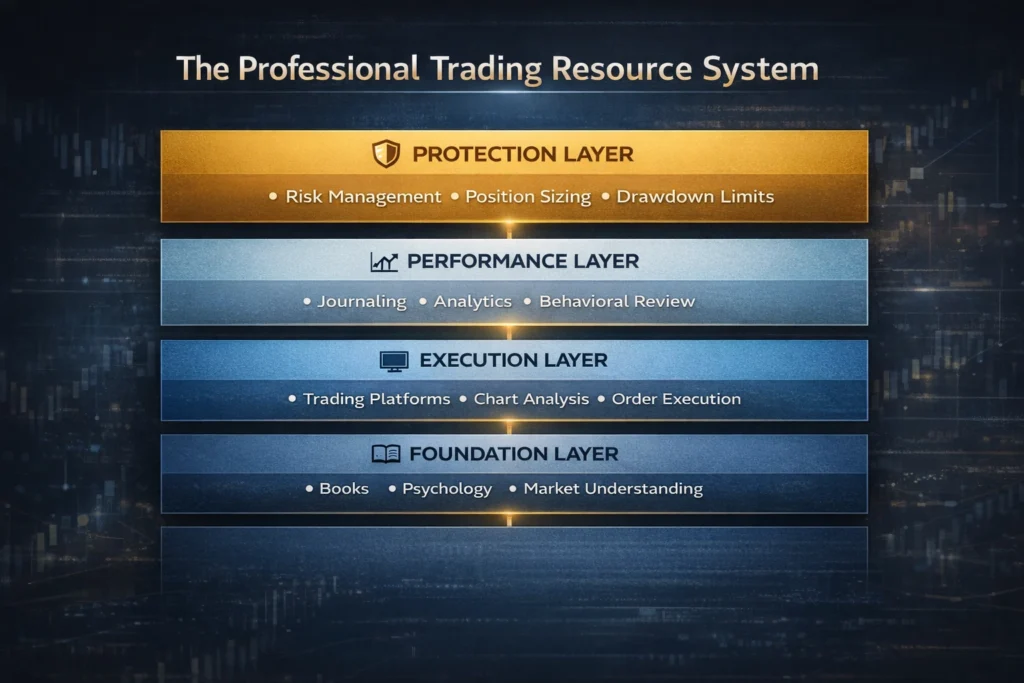
The Professional Trading Resource System
Risk Management Resources: The Real Edge
Most beginner traders spend their time searching for better entries.
Professional traders spend their time refining risk management.
Capital protection determines whether a trader survives long enough to develop skill. Without strict risk control, even profitable strategies can collapse during inevitable drawdowns.
Risk management resources often include books focused on capital preservation, position sizing calculators, and frameworks for managing drawdowns.
Position sizing models such as the fixed-percentage rule help traders control exposure relative to account size. Many traders also define daily and weekly loss limits that automatically stop trading after a predefined threshold.
These rules act as a psychological safeguard. When losses occur — which they inevitably will — the rules prevent emotional decisions that could otherwise escalate into catastrophic mistakes.
The Role of External Knowledge and Internal Frameworks
Learning from trusted sources is essential, but it must be balanced with personal analysis. Research in behavioral finance demonstrates that traders often fall victim to cognitive biases when making financial decisions under uncertainty. According to explanations of behavioral finance concepts found on authoritative educational sites such as the behavioral finance overview on Investopedia, biases like loss aversion and confirmation bias significantly influence trading behavior. Understanding these concepts helps traders develop stronger self-awareness, which is why developing strong remains a cornerstone of professional trading education.
Free vs Paid Trading Resources
The trading industry now offers an overwhelming number of paid tools, courses, and mentorship programs. However, the value of these resources varies widely.
Free resources are often sufficient for learning foundational concepts such as market structure, technical analysis basics, and risk principles. Many high-quality educational articles, interviews, and lectures are available online.
Paid resources become valuable when they provide structured learning, advanced analytics, or professional trading infrastructure. Examples include data feeds for futures trading, advanced journaling software, or structured mentorship programs that emphasize accountability and risk management.
The key question traders should ask before purchasing any resource is simple:
Will this improve my decision-making process?
If a tool only promises faster profits without strengthening discipline or analysis, it is unlikely to provide long-term value.
Common Mistakes Traders Make With Resources
Even experienced traders can misuse educational resources.
One of the most common mistakes is resource overload. Traders subscribe to multiple platforms, join several communities, and consume countless strategies simultaneously. Instead of gaining clarity, they create confusion.
Another mistake is focusing too heavily on indicators or signals. Tools can support analysis, but they cannot replace structured thinking.
Finally, many traders underestimate the importance of reviewing their own data. Without journaling or statistical tracking, improvement becomes difficult because mistakes remain invisible.
Successful traders simplify their resource stack and focus on tools that reinforce discipline rather than distraction.
Building Your Personal Trading Resource Stack
Rather than collecting tools randomly, professional traders build a structured resource system.
Early in the learning process, the focus should be on foundational education and basic chart analysis. As experience grows, performance tracking and risk management systems become more important.
Eventually, traders refine their environment by eliminating unnecessary tools and focusing only on resources that directly improve execution and decision-making.
This gradual approach ensures that resources support skill development instead of overwhelming the learning process.

Frequently Asked Questions
What are the most important trading resources for beginners?
Beginners benefit most from foundational books, a reliable charting platform, and a simple trade journal. These resources help develop understanding of market behavior, risk management, and performance analysis.
Are paid trading tools necessary to become profitable?
Not always. Many foundational concepts can be learned using free resources. Paid tools become valuable when they provide advanced analytics, professional data feeds, or structured educational programs.
What is the best charting platform in 2026?
The best platform depends on the market being traded. TradingView is widely used for chart analysis, while platforms like NinjaTrader or Sierra Chart are popular among futures traders. Forex traders often rely on MetaTrader 5.
Why is journaling important for traders?
Journaling allows traders to analyze patterns in their behavior and performance. By reviewing trade data over time, traders can identify mistakes, refine strategies, and improve consistency.
How many trading books should I read?
Depth matters more than quantity. Studying a few high-quality books carefully is more valuable than reading many superficially. Re-reading important concepts often leads to deeper insights.
Conclusion
Trading success rarely comes from discovering a single breakthrough strategy. Instead, it emerges from a structured process built over time.
The resources traders choose shape that process.
Books develop mental frameworks for understanding risk and probability. Platforms provide the environment where analysis and execution occur. Journaling tools reveal patterns in behavior that would otherwise remain hidden. Risk management systems protect capital during inevitable drawdowns.
When these elements work together, they create a professional trading infrastructure that supports consistent improvement.
But no resource can replace discipline.
Tools can amplify skill, yet they cannot create it. Communities can provide insight, yet they cannot make decisions on your behalf. Ultimately, the trader remains responsible for applying structure, protecting capital, and refining their process.
For traders who approach learning deliberately, the right resources can accelerate growth dramatically.
For those who chase shortcuts, even the best tools will only add noise.
In trading, clarity is an advantage. And building the right environment is one of the most powerful ways to achieve it.