

Table of Contents
Introduction
Cryptocurrency is frequently marketed as a fast track to wealth, a revolutionary shortcut to financial independence, and an opportunity that only the early and bold can truly benefit from, yet this narrative often creates more confusion than clarity for beginners who are trying to understand what they are actually participating in. Social media platforms are filled with dramatic success stories, screenshots of extraordinary gains, and simplified explanations that suggest crypto profits are inevitable for anyone willing to buy the “right” coin at the “right” time, but these portrayals rarely reflect the full reality of how cryptocurrency markets operate or the level of preparation required to navigate them responsibly.
For most newcomers, the crypto market feels overwhelming not because it is inaccessible, but because it is poorly explained. Technology, speculation, investing, and trading are often blended into a single narrative, leaving beginners unsure whether they are learning about innovation, participating in a financial experiment, or simply gambling on price movement. When losses arrive early, as they often do, confusion turns into frustration, and many assume crypto itself is flawed rather than recognizing that their approach lacked structure, patience, or understanding.
This guide is not designed to promise profits, highlight trending coins, or encourage immediate participation. Instead, it provides a grounded and realistic introduction to cryptocurrency for beginners who want to understand what crypto actually is, why it attracts intense speculation, and how newcomers can approach it with clarity rather than urgency. Cryptocurrency can represent meaningful financial innovation, but it is also an unforgiving environment for those who enter without education, realistic expectations, and risk awareness. The difference between these outcomes is not luck; it is preparation.
What Cryptocurrency Actually Is (Without the Hype)
At its foundation, cryptocurrency is not an investment strategy, a trading system, or a shortcut to wealth, but a technological framework designed to facilitate digital value transfer without relying on centralized authorities such as banks or governments. Cryptocurrency operates on blockchain technology, which is a decentralized ledger system where transactions are verified, recorded, and distributed across a network of participants rather than controlled by a single institution.
Blockchain technology was created to solve specific problems related to trust, transparency, and control in digital transactions, allowing individuals to send and receive value globally without intermediaries while maintaining a verifiable and tamper-resistant transaction history. This design removes the need for centralized trust, replacing it with cryptographic verification and distributed consensus, which fundamentally changes how financial transactions can occur.
Different cryptocurrencies exist for different purposes, and this distinction is often overlooked by beginners who view all crypto assets as interchangeable speculative instruments. Bitcoin was designed primarily as a decentralized form of digital money, while Ethereum introduced programmable smart contracts that enable decentralized applications and financial systems to operate without centralized oversight. Other cryptocurrencies focus on privacy, scalability, governance, or infrastructure, and each network represents a unique experiment in digital finance rather than a guaranteed financial opportunity.
Problems arise when technological innovation becomes overshadowed by speculation. As crypto adoption increased and prices began to move aggressively, public attention shifted away from utility and toward profit potential. Beginners stopped asking what a cryptocurrency was designed to do and began focusing almost exclusively on how much its price might increase, which fundamentally changes the decision-making process from informed participation to reactive speculation.
Buying an asset without understanding its purpose, structure, or risks is not investing; it is guessing. A realistic introduction to cryptocurrency begins with the recognition that price movement is a secondary outcome of adoption, demand, and speculation rather than proof of inherent value. Understanding this foundation allows beginners to approach crypto with curiosity and discipline instead of urgency and expectation.
Why Cryptocurrency Attracts Extreme Speculation
Cryptocurrency attracts speculative behavior more aggressively than almost any other financial market, and this dynamic is driven by a combination of structural design, market accessibility, and human psychology. Crypto markets operate continuously without closing hours, are accessible globally with minimal barriers to entry, and exhibit high volatility that can produce dramatic price swings within short timeframes, creating emotional intensity that few traditional markets can match.
Unlike equity markets, which are often tied to earnings reports, balance sheets, and established valuation frameworks, many crypto assets lack clear benchmarks for determining fair value. This absence of traditional valuation anchors makes narratives exceptionally powerful, allowing sentiment, social momentum, and online discourse to influence prices more strongly than fundamentals. For beginners, rising prices can easily be misinterpreted as validation of legitimacy rather than a reflection of speculative demand.
Social media amplifies this effect by prioritizing emotionally charged content, bold predictions, and simplified success stories, while thoughtful risk discussions and balanced analysis receive far less visibility. Beginners are therefore exposed to a skewed version of reality where upside is emphasized and downside is minimized, creating unrealistic expectations before any meaningful understanding has been developed.
Speculation itself is not inherently harmful, but it becomes dangerous when beginners fail to recognize that they are participating in a speculative environment. Without this awareness, volatility feels unfair, losses feel unexpected, and decision-making becomes reactive. A realistic approach to crypto requires acknowledging that speculation is a defining feature of the market and that participation without preparation exposes newcomers to amplified risk.
Common Beginner Mistakes in Cryptocurrency Markets
Most beginner losses in crypto do not occur because of poor coin selection but because of misaligned expectations and behavioral errors that emerge under emotional pressure. One of the most frequent mistakes is entering the market without a clear objective, as many beginners buy assets simply because they are trending, popular, or heavily discussed online, without understanding their purpose or risk profile.
Another common error is confusing short-term price movement with long-term value, which leads to excessive exposure during periods of rapid appreciation and emotional paralysis during drawdowns. When early gains occur, confidence often rises faster than competence, encouraging beginners to increase position sizes, ignore downside risk, or abandon exit plans, only to experience amplified losses when volatility reverses.
The always-open nature of crypto markets creates constant psychological pressure to monitor prices, react to news, and make decisions, which increases the likelihood of overtrading and impulsive behavior. Beginners also underestimate the importance of security practices, wallet management, and operational knowledge, which are critical in a decentralized environment where errors are often irreversible.
These mistakes are not signs of incompetence but predictable responses to an environment that rewards excitement over education. Recognizing these patterns early allows beginners to slow down, reset expectations, and approach cryptocurrency as a skill to be developed rather than an opportunity to be rushed.
Learning Before Risk: A Safer Entry Into Crypto
The safest way for beginners to approach cryptocurrency is by prioritizing learning over participation and familiarity over exposure. In crypto, rushing into positions without understanding the ecosystem can lead to losses that are not only financial but educational, as emotional stress often prevents meaningful learning once capital is at risk.
Observation is a critical first step, allowing beginners to watch price behavior, market cycles, and sentiment shifts without the pressure of real-money decisions. This phase provides valuable insights into volatility patterns and emotional responses, helping newcomers understand how quickly narratives can change and how uncertainty impacts decision-making.
Education should extend beyond price charts to include wallet security, custody options, blockchain fundamentals, and risk awareness, as crypto places responsibility directly on the user rather than intermediaries. Introducing risk gradually, in amounts small enough to allow mistakes without emotional distress, preserves the learning process and prevents survival-mode decision-making.
Approaching crypto safely does not mean avoiding it; it means respecting its complexity and acknowledging that long-term participation requires patience, structure, and continuous learning.
Crypto as Education, Not a Shortcut to Wealth
Viewing cryptocurrency as an educational environment rather than a financial escape fundamentally changes how beginners interact with the market. When learning becomes the primary objective, volatility transforms from a threat into information, mistakes become feedback, and progress is measured by understanding rather than short-term profit.
This mindset reduces emotional pressure, removes the urgency to act, and encourages thoughtful decision-making. Crypto evolves rapidly, and those who invest in understanding its mechanics, risks, and market behavior are better positioned to adapt than those who rely on hype or speculation.
To build a deeper and more resilient trading foundation, it is essential to connect psychological discipline with structured market awareness and risk management practices across different market environments, which is why readers who struggle with emotional decision-making and inconsistent risk application may benefit from our in-depth discussion on why traders ignore risk management and how behavior undermines even well-defined systems.
Similarly, gaining a thorough understanding of market structure concepts such as Break of Structure (BOS) and Change of Character (CHOCH) can significantly improve contextual decision-making and timing by highlighting where price is most likely to react, and for a broader perspective on how digital assets and decentralized technologies fit into the global financial landscape, resources such as the Investopedia guide to cryptocurrency provide clear, educational explanations of key mechanisms and terminology that help bridge the gap between technical understanding and real-world application.
How Crypto Market Cycles Reinforce Beginner Behavior
👉 Beginner Crypto Emotional Cycle
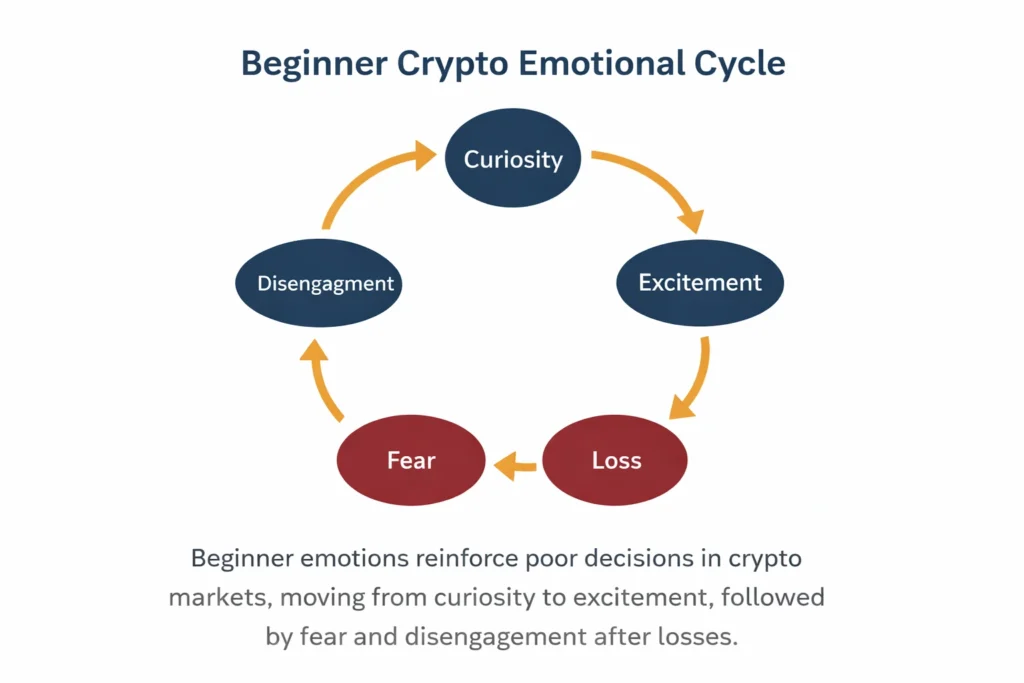
Key Differences Between Crypto and Traditional Markets
| Feature | Cryptocurrency Markets | Traditional Markets |
|---|---|---|
| Trading Hours | 24/7 | Limited sessions |
| Regulation | Evolving | Established |
| Volatility | Extremely high | Moderate |
| Custody Responsibility | User-managed | Institution-managed |
| Valuation Models | Emerging | Well-defined |
Understanding these differences helps beginners avoid applying traditional assumptions to a fundamentally different environment.
Learning Resources and Market Context
To build a structured understanding of cryptocurrency markets, beginners benefit from combining foundational education with market structure awareness, which explains how price movement reflects behavior rather than randomness. Concepts such as trends, market structure, and liquidity provide a framework for interpreting volatility rather than reacting emotionally to it, and readers can deepen this understanding by exploring structured market education through [INSERT INTERNAL LINK HERE], which explains how price behavior forms patterns across financial markets.
For broader context on how cryptocurrency functions within the global financial system, authoritative educational resources such as Wikipedia’s cryptocurrency overview (https://en.wikipedia.org/wiki/Cryptocurrency) provide neutral explanations of blockchain technology, market development, and regulatory considerations, helping beginners separate factual information from speculative narratives.
Frequently Asked Questions (FAQ)
Is cryptocurrency investing or gambling for beginners?
Cryptocurrency can be a legitimate investment or a form of speculation depending on how it is approached, and for beginners, the distinction depends entirely on preparation, risk management, and understanding rather than the asset itself.
Do beginners need to trade to participate in crypto?
Trading is not required to engage with cryptocurrency, as beginners can focus on learning, holding small positions, or studying market behavior without active trading.
Why is crypto so volatile compared to stocks?
Crypto volatility is driven by speculative demand, lower liquidity in many assets, evolving regulation, and the absence of established valuation models.
Is it too late to learn about cryptocurrency?
Learning is never too late, as crypto continues to evolve, but rushing into positions without education remains risky regardless of timing.
How much should a beginner risk in crypto?
Beginners should risk only amounts small enough to allow learning without emotional distress, ensuring mistakes do not disrupt financial stability or decision-making.
Conclusion: Learning First, Risking Later
Cryptocurrency is neither a guaranteed path to wealth nor a phenomenon to dismiss without understanding, but a complex and evolving financial ecosystem that rewards preparation and punishes impulsiveness. Most beginner losses do not result from bad timing or flawed technology but from unrealistic expectations, emotional decision-making, and insufficient education.
A realistic introduction to crypto begins with patience, curiosity, and respect for uncertainty, allowing beginners to build knowledge before exposure and confidence before commitment. By treating crypto as an educational journey rather than a shortcut, newcomers give themselves the best chance to participate responsibly, adapt to change, and avoid the costly mistakes that arise when learning is treated as optional.
Crypto is not about speed, and it is not about hype, but about understanding, and understanding requires time, discipline, and intentional learning.