

Table of Contents
Introduction — Why So Many “Good Trades” Die Before They Pay
If you have ever watched a trade close automatically even though your analysis was correct, you have already felt the real danger of margin trading. One moment everything looks fine, and the next your position disappears, leaving you staring at a screen that says “margin call” or “liquidation” without any warning that made sense. This is one of the most frustrating experiences a trader can have because it feels unfair, random, and deeply confusing, especially when price later moves in the direction you predicted.
Most beginners believe their losses come from bad entries or wrong market direction, but in reality many accounts are wiped out by something far quieter and more mechanical. It is not the chart that ends most trades. It is not the news. It is not even poor strategy. It is the way borrowed capital interacts with account limits in the background. This invisible system is why so many traders feel like they are always “almost right” but still losing money.
This guide exists to remove that confusion. By the time you finish reading, you will understand why trades close unexpectedly, how risk thresholds really work, and how professional traders structure their exposure so that normal drawdowns do not turn into catastrophic losses. If your goal is consistency, funded accounts, or real capital growth, learning how margin trading actually behaves is not optional. It is survival.
What Margin Trading Really Means in Real Life
Most beginners think margin is simply the money required to open a trade, but that description hides the most important part of how the system works. In reality, margin trading is a way of controlling a larger position than your account would normally allow by temporarily locking part of your capital as collateral. That collateral exists for one reason only: to protect the broker or prop firm if the market moves against you.
When you open a position using borrowed exposure, you are not gaining an edge or improving your accuracy. You are increasing how sensitive your account becomes to price movement. A small move in price becomes a much larger move in equity, which is why this form of trading feels exciting at first and brutal later. The market itself has not changed. Only the speed at which you can lose money has.
The most important thing to understand is that this collateral is not available to you while the trade is open. It is locked. If losses grow large enough to consume your remaining free funds, your position will be closed automatically, even if your stop loss has not been hit and even if the market later reverses. This is what surprises so many traders because they are focused on the chart while the account mechanics are quietly deciding whether their trade is allowed to continue.
Why Most Traders Misunderstand This System
The reason margin trading causes so much confusion is because it works invisibly. You never see it on the chart. You do not feel it when trades are going well. It only becomes obvious when something goes wrong. Most platforms show account balance, profit and loss, and open positions, but they rarely highlight the most important number of all: how much room you have left before the system intervenes.
Beginners tend to focus on being right. They look at indicators, patterns, and news, believing that if their analysis is correct the trade will eventually work. Professionals focus on something else entirely. They focus on whether their account can survive being wrong. That difference in thinking is what separates traders who last from traders who keep blowing up.
Maintenance Margin — The Hidden Line That Ends Trades
Most traders think there is only one margin number: the amount required to open a trade. In reality, there are two separate thresholds, and the second one is far more dangerous.
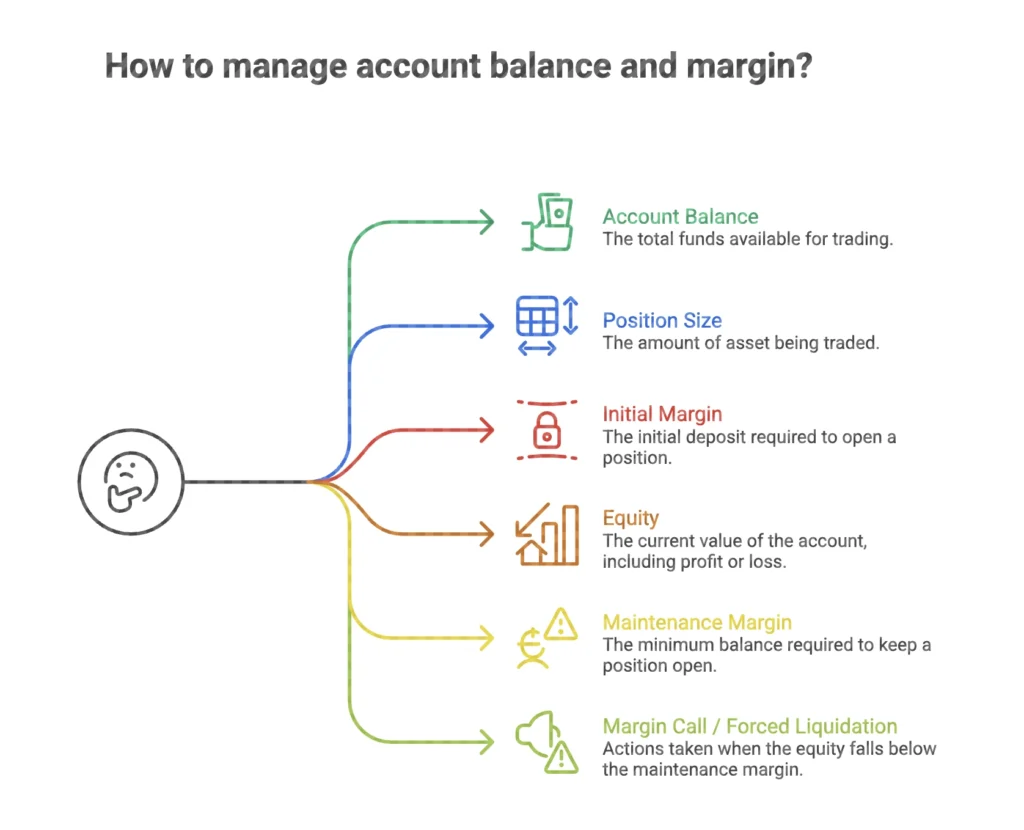
The first is initial margin. This is the amount of capital that must be locked in order to open a position.
The second is maintenance margin. This is the minimum amount of equity that must remain in the account to keep the position open.
Once equity falls below this maintenance level, the platform is allowed to intervene automatically. This is why trades often close “out of nowhere,” even though nothing unusual happened on the chart.
The danger is that maintenance margin is rarely shown clearly on most platforms. Beginners assume the locked collateral stays fixed, but in reality the safety threshold is constantly being tested by losses, spreads, and volatility.
This is why two traders can take the same trade, see the same price movement, and get very different results. One sized small and had room to breathe. The other pushed their exposure too far and crossed the maintenance line.
If a trade only survives as long as margin remains untouched, the position was too big from the start.
A Simple Table That Changes Everything
Here is how the account mechanics actually work in a typical margin-based environment:
| Term | What It Means | Why It Matters |
|---|---|---|
| Account Balance | Your total funds | Not what keeps trades open |
| Used Funds | Capital locked for positions | Cannot be spent or reused |
| Free Funds | Capital available to absorb losses | This is your survival buffer |
| Equity | Balance plus open profit or loss | What liquidation is based on |
| Maintenance Level | Minimum required to stay open | When crossed, trades close |
Most beginners stare at their balance. Professionals monitor their free funds and equity.
How Trades Really Die Inside a Live Account
Imagine you deposit two thousand dollars into your account and open a position that requires one thousand dollars of collateral. That means half of your money is now locked. You may still see two thousand on your screen, but in reality only one thousand is available to absorb losses. That is your buffer.
Now the trade moves against you. A loss of three hundred dollars does not feel dramatic, but it has already consumed nearly a third of your buffer. A loss of six hundred means most of your safety cushion is gone. When that free amount approaches zero, the platform steps in. It does not care that your stop loss is further away. It does not care that price might reverse. It only cares that the account no longer meets its safety requirements.
This is why so many traders say, “My stop loss wasn’t hit, so why did my trade close?” The answer is that the account mechanics intervened before your technical exit ever had a chance.

A Real Step-by-Step Margin Breakdown (With Numbers)
To truly understand why trades get closed unexpectedly, you need to see how the numbers change as price moves. Most beginners never do this, which is why margin events feel random and unfair when they happen.
Imagine the following realistic trading setup:
- Account balance: $2,000
- Position size: $10,000
- Required collateral: $1,000
The moment you open the trade, half of your money is no longer free. Your account now looks like this:
- Balance: $2,000
- Locked funds: $1,000
- Free buffer: $1,000
That free buffer is the only thing protecting your trade from being shut down.
Now price moves slightly against you.
The trade shows a loss of $300.
- Account equity: $1,700
- Locked funds: $1,000
- Free buffer: $700
Nothing looks dramatic on the chart, but almost one third of your survival space is already gone.
Price continues moving.
The loss reaches $700.
- Account equity: $1,300
- Locked funds: $1,000
- Free buffer: $300
Now every small candle feels dangerous, even though price may still be well within a normal range.
Price dips again.
The loss reaches $1,000.
- Account equity: $1,000
- Locked funds: $1,000
- Free buffer: $0
At this point the platform is no longer willing to let the trade exist. Depending on the broker or prop firm, you will either receive a margin call or the position will be closed automatically. This can happen even if your stop loss is far away and even if price reverses moments later.
This is the moment most beginners say, “My trade was right, but it still failed.”
In reality, the trade did not fail — the account did.
👉 How Margin Limits a Trade
The Difference Between Exposure and Survival
One of the most dangerous misunderstandings in trading is thinking that bigger positions mean faster success. In reality, they mean less room to be wrong. Professionals size trades so that normal losses do not threaten their ability to stay in the game. Beginners often do the opposite, using all available buying power and leaving no margin for error.
If you risk one percent of your account per trade, you can survive long losing streaks. If you risk ten or twenty percent, you are one bad day away from disaster. This is why consistency is not about finding better entries. It is about structuring risk so that mistakes do not end your career.
Why This Is Even More Dangerous in Funded Accounts
Prop firms give traders access to large amounts of capital, which makes everything feel safer at first. In reality, the rules are stricter. Daily loss limits, trailing drawdowns, and account resets mean that even a few oversized trades can end a funded account instantly.
Many traders fail funded challenges not because their strategy is bad, but because their risk is misaligned with the account rules. This is why understanding exposure mechanics is just as important as understanding the market. If you want a deeper look at how misuse of buying power destroys traders, this breakdown of seven brutal leverage mistakes explains how quickly things can go wrong.
At the same time, learning how to protect open profits and avoid emotional exits is what keeps traders alive during drawdowns, which is why the principles in profit protection and trading psychology matter so much in this context.
For a neutral financial explanation of how margin and leverage work together in regulated markets, Investopedia’s guide is one of the clearest public resources available.
Common Mistakes That End Accounts
Most failures come from the same patterns. Traders treat locked collateral as usable money. They increase position size after losses. They ignore how little free buffer remains. They trade volatile sessions without adjusting risk. None of these are strategy problems. They are exposure problems.
When you hear someone say they were “unlucky,” it is usually because their position was too large for their account to survive normal market movement.
Why Professionals Rarely Get Margin Calls
Experienced traders structure their trades so that margin never becomes a threat. They risk small percentages of their account. They keep large buffers of free funds. They reduce size during volatile sessions. Most importantly, they think in terms of survival, not profit.
This is why their equity curves look smooth while beginners’ accounts look like heart monitors.
FAQ — What Traders Actually Want to Know
Why do trades close before my stop loss is hit?
Because the account hit its margin threshold first. The platform is protecting itself, not your trade idea.
Is margin trading bad?
No, but misusing it through oversized positions is one of the fastest ways to lose money.
Can I trade safely with margin?
Yes, if position size is small and free funds remain high at all times.
Why does this happen faster in crypto?
Because volatility is higher, which eats through free funds more quickly.
Do funded accounts make this safer?
No. The rules are stricter, so mistakes are punished faster.
A Beginner Survival Framework for Margin-Based Trading
If you are in your first year of trading, your goal is not to grow an account aggressively. Your goal is to stay in the game long enough to develop skill. That requires treating margin as a boundary, not a resource.
These rules are what protect serious beginners from blowing up:
- Never use all available margin, even if the platform allows it
- Always leave a large free buffer before entering a trade
- Reduce position size during news, opens, and volatile sessions
- Stop trading for the day if free margin starts to feel tight
- Treat stress and panic as a signal that exposure is too high
- Focus on survival first, profit second
The fastest way to fail is to trade at the limit of what the account allows. The fastest way to succeed is to trade at a level where losses do not threaten your emotional stability or your ability to continue tomorrow.
When margin never becomes a threat, trading becomes calm, consistent, and sustainable.
Final Thoughts — Why Survival Always Comes First
The market does not owe you profits. It only gives you opportunities. Your job as a trader is not to win every trade, but to stay alive long enough to let your skill compound. Margin trading is not a shortcut. It is a test of discipline. When you respect it, it becomes a tool. When you ignore it, it becomes a trap.
If you take one lesson from this guide, let it be this: the traders who last are not the ones who trade the biggest. They are the ones who leave themselves room to be wrong.