

Table of Contents
Introduction: The Mistake Almost Every Trader Makes
You do not break your trading rules because you lack discipline.
You break them because your nervous system overrides your discipline.
Most traders believe their biggest weakness is mental. They think they need stronger focus, better emotional control, tighter self-talk, or more confidence. So they study mindset, repeat affirmations, promise themselves they will “stick to the plan,” and approach the next session determined to perform better.
And then the market moves fast against them.
A stop approaches.
Volatility spikes.
A funded account nears its daily loss limit.
Suddenly something shifts.
They close winners too early.
They widen stops.
They hesitate.
They overtrade.
They try to win back losses.
Afterward, they tell themselves the same story: “I just need more discipline.”
But discipline is not the root issue.
The real issue is that when uncertainty increases, your body interprets it as threat. Once threat is perceived, your survival system activates. And when that happens, structured execution collapses.
This article will explain why traditional trading psychology advice often fails, how your autonomic nervous system hijacks execution, why funded trading amplifies this effect, and how professional traders deliberately train regulation instead of relying on willpower.
If you want consistent execution in 2026 and beyond, you must understand one uncomfortable truth:
Trading is not just cognitive.
It is physiological.
The Core Misunderstanding: Psychology Is Not Just Mindset
The trading industry talks endlessly about mindset. Traders are told to think positively, control emotions, build confidence, and strengthen discipline. While these concepts matter, they ignore a deeper mechanism that drives real-time behavior.
Your brain does not operate independently.
It constantly receives signals from your nervous system. And your nervous system does not care about expectancy, R-multiples, or statistical edges. It cares about safety.
When you enter a trade, your rational brain understands probability. But when price accelerates against your position, your nervous system reacts instantly. Heart rate increases. Breathing becomes shallow. Muscles tighten. Cortisol and adrenaline rise. Attention narrows toward the perceived danger.
Your body does not interpret this as “normal variance.”
It interprets it as potential threat.
And once the survival system activates, the rational system loses dominance.
This is why discipline fails under pressure. Discipline requires a calm prefrontal cortex. But when the survival system dominates, the prefrontal cortex becomes less influential. You are no longer calmly executing a structured plan. You are seeking relief.

The Two Systems Governing Every Trade
Every trading decision is influenced by the interaction between two systems:
| Thinking System | Survival System |
|---|---|
| Prefrontal cortex | Autonomic nervous system |
| Logical and analytical | Reactive and protective |
| Probability-based | Threat-based |
| Long-term oriented | Immediate relief oriented |
| Enables discipline | Overrides discipline under stress |
In calm market conditions, the thinking system leads.
Under volatility, drawdown, or time pressure, the survival system takes over.
The issue is not intelligence.
It is activation threshold.
The lower your stress tolerance, the faster your survival system activates.
Fight, Flight, Freeze: The Biological Roots of Trading Mistakes
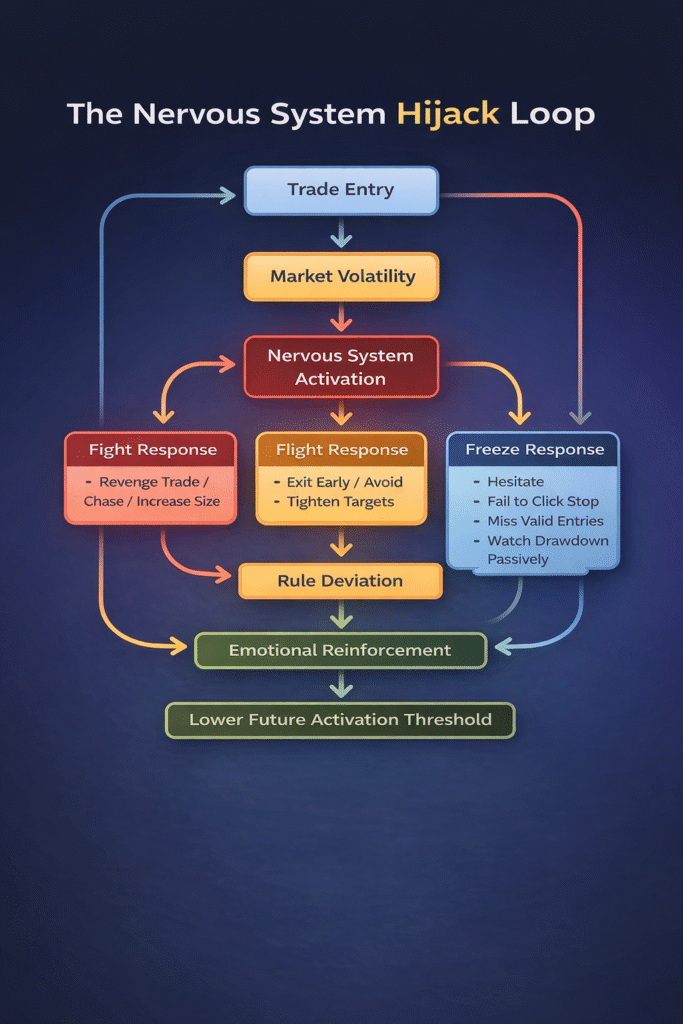
Every execution error typically maps to one of three biological survival responses.
1️⃣ Fight Response – “I’ll Win It Back”

The fight response appears as aggression toward the market. After a loss, adrenaline increases. Urgency builds. The trader feels compelled to act.
This shows up as:
- Revenge trading
- Increasing position size impulsively
- Forcing marginal setups
- Ignoring invalidation levels
- Refusing to accept being wrong
The goal shifts from structured execution to emotional correction.
In funded trading environments, this response is especially dangerous. Daily loss limits and trailing drawdowns leave little room for aggressive emotional behavior. What feels like determination often becomes rule violation.
2️⃣ Flight Response – “Get Me Out”

The flight response prioritizes safety. Even valid trades feel uncomfortable. Volatility feels threatening.
This shows up as:
- Closing winners too early
- Tightening take-profits irrationally
- Skipping valid setups after losses
- Reducing size out of fear
- Exiting at minor pullbacks
Short-term relief replaces long-term expectancy.
Over time, this destroys R-multiples and erodes edge — even with a profitable strategy.
3️⃣ Freeze Response – “I Can’t Act”
Freeze is paralysis. It occurs when stress exceeds capacity.
This shows up as:
- Failing to execute stop losses
- Watching drawdown without acting
- Missing ideal entries
- Hesitating until opportunity disappears
Afterward, traders often say, “I don’t know why I didn’t click.”
The reason is physiological overload.
👉 The Nervous System Hijack Loop
Why Funded Trading Amplifies Stress
Funded trading intensifies nervous system activation because it adds structural boundaries.
Daily loss limits.
Maximum drawdowns.
Profit targets.
Violation thresholds.
These rules create measurable edges of safety.
When approaching a daily loss limit, every tick carries more psychological weight. The body senses proximity to danger. Breathing shifts. Heart rate increases. Focus narrows.
Even if your setup remains statistically valid, your physiology may not cooperate.
Profit targets create urgency. Time constraints signal pressure. Pressure reduces patience. Reduced patience lowers trade quality.
This is why traders often pass evaluation challenges but struggle once funded. The difference is not strategy. It is regulation capacity under constraint.
Research from behavioral science consistently shows that stress narrows cognitive flexibility and increases reactive behavior. This aligns directly with the execution principles discussed in structured trading psychology frameworks, where risk control is treated as both strategic and physiological.
A Note on Stress, Decision-Making, and Execution
Understanding why trading discipline breaks down under pressure requires looking beyond charts and into behavioral science. Research on stress and cognitive performance, including findings summarized by the American Psychological Association on how stress impairs decision-making, explains why traders behave differently once volatility rises. This dynamic directly connects with the execution and risk-control principles discussed throughout our trading psychology framework, where emotional regulation is treated as a structural performance skill rather than a motivational concept.
Common Mistakes Traders Make
Many traders attempt to solve physiological problems with cognitive tools.
They rely on willpower during drawdowns, not realizing willpower depletes under stress.
They scale position size too quickly, overwhelming their nervous system before adaptation occurs.
They overload charts with excessive indicators, increasing cognitive strain and baseline tension.
They ignore sleep, physical activity, and caffeine management, lowering stress tolerance before trading begins.
They criticize themselves harshly after mistakes, reinforcing stress loops instead of breaking them.
These errors are not strategic failures. They are regulation failures.
Why Discipline Alone Is Not Enough
Discipline is a cognitive command.
Regulation is a physiological capacity.
Without regulation, discipline becomes fragile. Under low stress, it works. Under volatility, it collapses.
Consistency requires expanded capacity to remain stable under uncertainty.
The more regulated your nervous system, the more accessible your logical brain remains during stress.
How Professional Traders Train Regulation
Professional traders do not just train strategy. They train state.
Baseline Stability
They prioritize sleep, hydration, physical movement, and controlled caffeine. Chronic stress lowers activation thresholds. A stable baseline increases resilience.
Real-Time Regulation
They use slow nasal breathing with extended exhales during volatility. This activates the parasympathetic system and reduces fight-or-flight activation.
Decision Environment Simplification
They reduce chart clutter, trade defined sessions, and follow structured setups. Lower cognitive load supports regulation.
Pre-Acceptance of Loss
Before entering a trade, they mentally accept the full risk. This reduces shock if stops are hit.
Gradual Exposure
They scale risk incrementally. The nervous system adapts over time, not instantly.
Consistency emerges from capacity expansion, not motivational intensity.
A Practical Daily Regulation Framework
Pre-Market
Spend five minutes regulating breath. Confirm emotional neutrality. Ensure you are trading to execute structure, not to make money.
During Trades
Monitor physiological signals as carefully as price. If tension rises, pause and reset before adjusting.
Between Trades
Reset state. Wins and losses both distort perception.
After Session
Close charts intentionally. Move physically. Disconnect from screens. Prevent chronic activation.
This is not mindset work.
It is performance conditioning.
Conclusion: Calm Is the Real Competitive Edge
Markets will always contain uncertainty. Strategies are widely accessible. Education is everywhere.
Execution is the separator.
Execution is physiological.
When your nervous system remains regulated:
- You respect stops
- You let winners reach targets
- You avoid forced trades
- You maintain structure during drawdown
- You think probabilistically
When activation dominates:
- You react
- You overtrade
- You freeze
- You abandon plan
- You spiral
The real edge in 2026 is not secret indicators or proprietary systems.
It is regulation under pressure.
Your brain understands probability.
Your strategy defines structure.
Your nervous system determines execution.
Train the third, and the first two finally work.
Consistency is not built by thinking harder.
It is built by staying regulated longer.
That is where real trading psychology begins.