
Table of Contents
Introduction: The Hidden Paradox Behind Trading Failure
One of the most confusing realities in trading is that most traders already understand the basic principles of risk management, yet still struggle to apply them consistently when it matters most. They know that losses should be kept small, that stop-losses exist to protect capital, and that emotional decision-making leads to long-term damage, but despite this awareness, account balances continue to shrink rather than grow. This contradiction creates frustration and self-doubt, leaving many traders wondering why knowledge alone does not translate into results.
The problem is not that risk management rules are unclear or difficult to understand. In fact, most trading education emphasizes them heavily, often repeating the same advice about position sizing, stop placement, and loss limits. The real issue emerges when theory meets reality. Live markets introduce uncertainty, pressure, and emotional intensity that no backtest or demo environment can fully replicate. Under these conditions, even the most rational plans can collapse as instinct and emotion override logic.
This article explores why traders ignore risk management even when they know the rules, focusing not on formulas or technical settings, but on the psychological, emotional, and behavioral forces that undermine discipline. By understanding these forces, traders can begin to close the gap between knowledge and execution, transforming risk management from a theoretical concept into a consistent habit that protects both capital and decision-making.
The Knowledge–Execution Gap in Trading
One of the most overlooked challenges in trading is the gap between understanding what should be done and actually doing it in real time. Many traders invest countless hours learning strategies, refining setups, and writing detailed trading plans, only to abandon those plans the moment real money is at risk. On paper, everything appears logical, structured, and manageable, yet live trading introduces emotional variables that fundamentally change behavior.
This knowledge–execution gap exists because learning occurs in a calm, rational environment, while execution happens under pressure. When price moves rapidly, losses accumulate, or expectations rise, the brain shifts focus from long-term planning to immediate emotional relief. Traders find themselves taking trades they know they should avoid, ignoring rules they personally created, or increasing risk in moments of frustration, even while being fully aware that these actions contradict their own system.
Execution failures are not a sign of low intelligence or poor education. They are a sign that trading is an emotional performance skill, not just a technical one. Until traders recognize that discipline is a behavioral challenge rather than an informational one, they continue adding more rules, more indicators, and more complexity, believing clarity will solve the problem. In reality, consistency emerges only when traders learn to operate correctly under emotional stress, not when they accumulate more knowledge.
Why Emotional Pressure Overrides Risk Rules
Risk management rules are easiest to follow when emotional pressure is low and recent outcomes are neutral. However, markets rarely remain in such conditions for long. Losses often cluster, volatility increases unexpectedly, and traders begin to feel urgency to recover or prove competence. It is precisely during these moments that discipline becomes fragile and risk rules are most likely to be ignored.
Emotional pressure alters how decisions are evaluated. Instead of thinking in probabilities and long-term expectancy, the mind begins to focus on immediate outcomes and emotional discomfort. The priority shifts away from protecting capital and toward reducing stress, frustration, or fear. Under pressure, risk limits feel restrictive rather than protective, and stop-losses feel premature instead of necessary.
This explains why traders often break rules after losses rather than before them. A losing streak creates psychological urgency, making patience feel unbearable. Thoughts such as “I need to recover,” “this trade feels different,” or “I’ll be disciplined later” temporarily justify impulsive behavior while quietly increasing long-term damage. The market does not force these decisions; they arise from internal emotional reactions to uncertainty and disappointment.
Professional traders treat emotional pressure as information rather than instruction. When pressure rises, they reduce exposure, slow down, or step away entirely, understanding that emotional intensity signals vulnerability rather than opportunity. Traders who fail to recognize this pattern often mistake pressure for momentum, entering the most dangerous phase of their trading behavior.
Dopamine, Hope, and the Urge to Recover Losses
To fully understand why traders abandon risk management, it is essential to understand the role of dopamine in decision-making. Trading continuously stimulates the brain’s reward system because every potential trade carries the possibility of profit, and anticipation alone triggers dopamine release. This chemical response does not wait for confirmation or results; it activates before outcomes are known.
After a loss, discomfort appears, and the brain instinctively seeks relief. Hope becomes the psychological bridge between pain and action, creating the illusion that the next trade can immediately fix the situation. Under the influence of dopamine and hope, restraint feels like surrender, while action feels productive, even if it violates risk rules.
This mechanism explains why traders often increase position size, lower entry standards, or ignore daily loss limits after losing trades. These actions are not driven by analysis but by the desire to escape emotional discomfort. Taking action provides temporary relief, reinforcing the cycle, even as risk exposure increases.
Experienced traders learn to recognize this pattern as a biological response rather than a market signal. They understand that losses are inevitable, but the urge to erase them immediately is optional. When emotional recovery becomes intertwined with strategic decisions, risk management loses authority precisely when it is needed most.
Ego, Identity, and the Need to Be Right
Another powerful force that undermines risk discipline is ego, particularly the way traders attach identity to outcomes. Every trade becomes a personal judgment, not just of a setup, but of intelligence, competence, and self-worth. When price moves against a position, it does not simply feel like a loss; it feels like being wrong.
For many traders, being wrong is more threatening than losing money. Closing a losing trade confirms a mistake, while holding the position allows uncertainty and hope to persist. Ego reframes rule-breaking as intelligence, turning widened stops into “flexibility” and oversized positions into “confidence,” while the real motive is avoiding the discomfort of admitting error.
Professional traders separate identity from execution. They expect to be wrong regularly and do not interpret losses as personal failures. This detachment removes emotional resistance, allowing stop-losses to be respected without internal conflict. Until traders decouple self-worth from individual outcomes, risk management remains conditional, enforced only when ego feels safe.
Fear of Being Wrong Versus Fear of Losing Money
Although traders often believe their primary fear is financial loss, the deeper fear is frequently being wrong. Money can be reframed logically as a business expense, but being wrong challenges confidence and self-image. This distinction explains why traders often tolerate growing losses while refusing to exit positions early.
Small losses demand immediate acceptance, while larger losses allow denial to persist. This dynamic leads to subtle violations of risk rules, such as delayed exits or widened stops, which feel justified emotionally even as they undermine long-term performance. Professional traders cultivate emotional maturity by accepting error quickly and without judgment, understanding that mistakes are inherent in probabilistic environments.
Stress, Pressure, and the Collapse of Discipline
Stress is an unavoidable element of live trading, and it fundamentally changes how decisions are processed. Under stress, the brain shifts into survival mode, narrowing perception and prioritizing immediate relief over long-term planning. Risk management rules that feel reasonable during calm periods begin to feel restrictive during stress.
This explains why discipline often collapses at the worst possible moments, when losses accumulate or volatility increases. Traders under stress tend to trade more, not less, believing effort will solve the problem, while professionals do the opposite by reducing exposure and protecting mental capital. Discipline does not collapse because traders lack care; it collapses because stress silently alters decision-making priorities.
👉 Emotional Trading Cycle Diagram
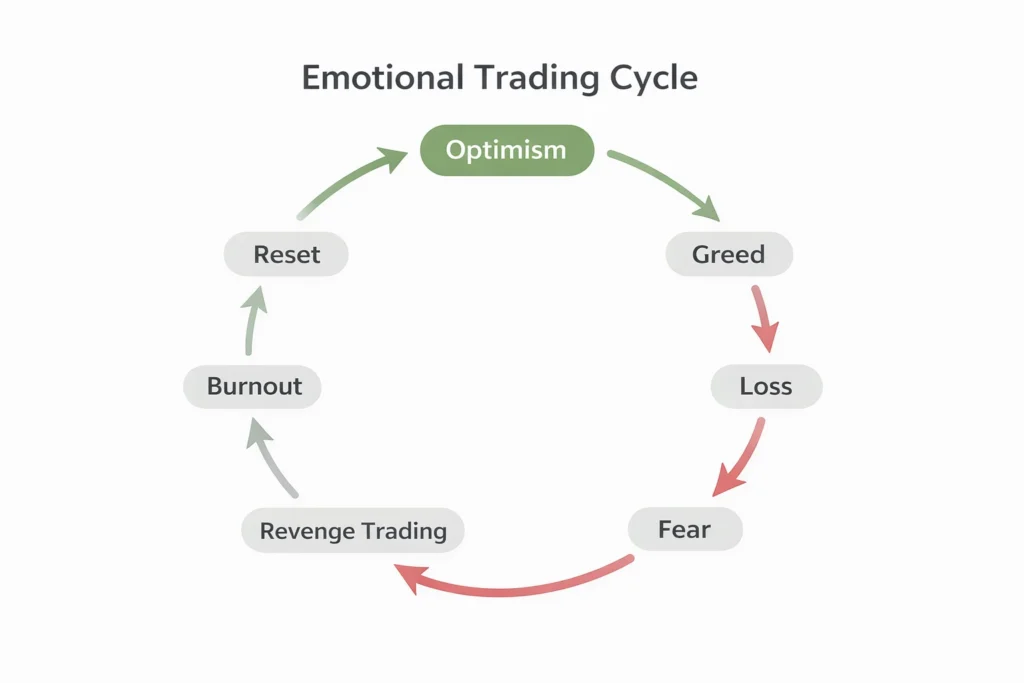
This emotional trading cycle highlights the most common psychological loop traders fall into, beginning with optimism and confidence, escalating into greed, followed by losses that trigger fear, revenge trading, emotional exhaustion, and ultimately a reset before the cycle starts again. Understanding this pattern is critical because risk management failures rarely happen randomly; they happen at predictable emotional stages where discipline collapses under pressure.
Why Psychology Is the Missing Piece of Risk Management
Most traders approach risk management as a technical challenge, believing that once rules are defined, discipline will naturally follow. However, rules do not control behavior; psychology does. Risk management exists at the intersection of logic and emotion, and when emotional awareness is missing, rules function only in ideal conditions.
Psychological understanding does not eliminate losses, but it reduces the damage caused by emotional reactions. Traders who understand their internal patterns recognize warning signs early and respond defensively rather than impulsively. Risk management becomes a self-regulation tool rather than a rigid checklist.
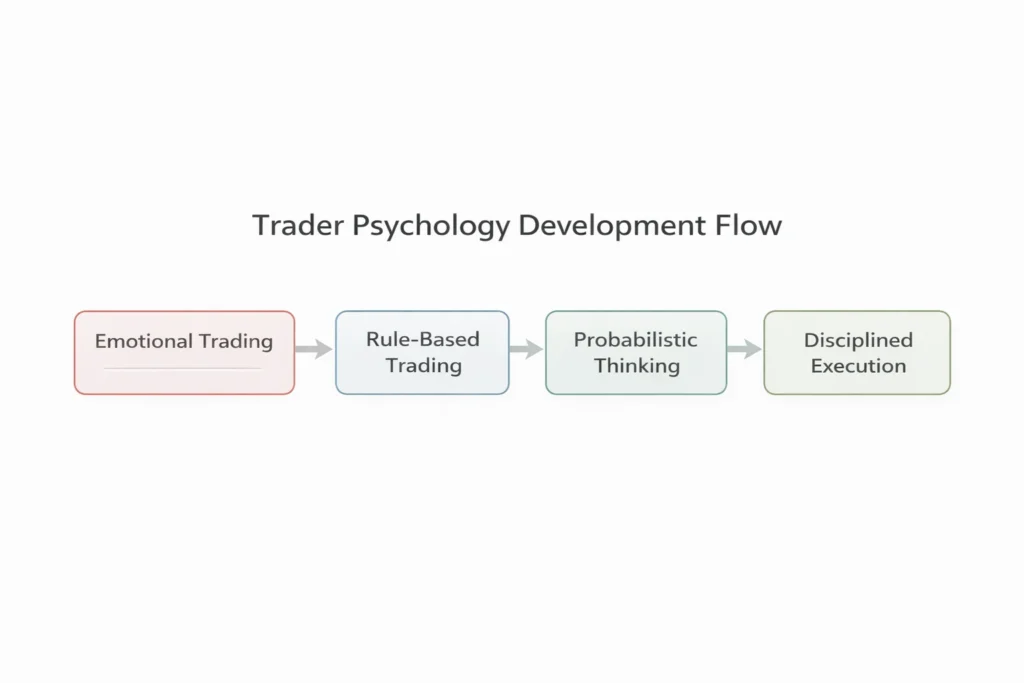
👉 Trader Psychology Development Flow
Risk Management Behaviors: Amateur vs Professional
| Aspect | Amateur Trader | Professional Trader |
|---|---|---|
| Reaction to loss | Urgent, emotional | Calm, analytical |
| Use of stops | Often adjusted or ignored | Always respected |
| View of being wrong | Personal failure | Expected outcome |
| Risk exposure | Increases under stress | Decreases under stress |
| Decision focus | Outcome-driven | Process-driven |
Linking Risk Psychology With Market Structure
Risk discipline improves significantly when traders align psychology with structure. Understanding market context reduces impulsive decisions by grounding entries and exits in objective conditions rather than emotional urgency. For a deeper technical foundation on this relationship, traders should study structured frameworks such as BOS and CHOCH, which are explained in detail in our market structure guide that shows how professional traders align execution with higher-probability market conditions. At the same time, discipline cannot exist without a clearly defined process, and traders who lack a written framework often break rules under pressure, making it critical to develop a structured trading plan that defines risk per trade, execution rules, and behavioral boundaries before entering the market.
From an academic perspective, research into behavioral finance clearly demonstrates how cognitive biases and emotional responses influence financial decision-making under uncertainty, reinforcing why risk management failures are rarely technical and are instead rooted in human psychology, a concept well documented in foundational behavioral finance studies.
Frequently Asked Questions (FAQ)
Why do traders break risk rules even when they know better?
Because emotional pressure overrides logic under uncertainty, causing traders to prioritize emotional relief over long-term consistency.
Is risk management more psychological than technical?
Yes, while the rules are technical, consistent application depends primarily on emotional regulation and behavioral discipline.
Can better strategies fix poor risk discipline?
No, better strategies cannot compensate for emotional execution failures, and often amplify losses when discipline breaks.
How can traders improve risk management consistency?
By reducing position size, simplifying rules, tracking emotional states, and treating stress as a warning signal.
Do professional traders still feel emotion?
Yes, but they do not allow emotion to dictate execution, instead relying on structured processes.
Conclusion: Risk Management Is Self-Management
Most traders do not ignore risk management because they are careless or uninformed. They ignore it because trading places the human mind under conditions it was not designed to handle easily, combining uncertainty, rapid feedback, and personal responsibility for outcomes. Under these conditions, knowledge alone is insufficient.
Risk management fails when behavior overrides intention, and behavior is shaped by psychology. The traders who survive long term are not those with the most complex strategies, but those who learn to manage themselves first. Protecting capital begins with protecting decision-making, and discipline emerges not from motivation, but from understanding how the mind behaves under pressure.
When traders master this, risk management stops feeling restrictive and begins to feel empowering, forming the foundation for consistency, longevity, and professional growth in the markets.